Showing posts with label Chauhan. Show all posts
Showing posts with label Chauhan. Show all posts
Wednesday, May 12, 2021

Poetry Reading and Songs: Fazeel Chauhan at the December 2017 show in Anaheim, California
Poetry Reading and Songs
Fazeel Chauhan Show
12-29-17

Fazeel Chauhan Art Exhibit: 2007 Xenophobia Leads to War
Fazeel Chauhan Art Exhibit: 2007
http://vizualeyezart.blogspot.com/2007/11/fazeel-chauhan-fazeel-chauhan-fazeel.html
1) Xenophobia Leads to War (Graphic Art / Found Art)
2) Profiles in Racism (Graphic Art)
3) Religious Epicenter (Mixed Media)
Naya Hukamnama: The New Ordinance: Javed Akhtar's Poem translated by Fazeel Chauhan
Javed Akhtar's Poem translated from Urdu to English
by Fazeel Chauhan
The New Ordinance, Naya Hukmnama, By Poet Javed Akhar, With Subtitles, Translation Fazeel Chauhan
the new ordinance, naya hukmnama, by poet javed akhar, with subtitles, translation fazeel chauhan. revolutionary. beautiful poetry by well known poet javaid akhtar naya hukm naama kisi ka hukm hai saari hawayein humesha chalne se pehle batayein ke unki simt nayahukmnama
someone has decreed that all the winds must first announce their direction before blowing—a poem by javed akhtar. poem: naya hukumnama written by: javed akhtar.
Interview for: Art ‘Portal’ Connects LA With Iraqi Refugees – in Real Time
Fazeel Chauhan interviewed for the article:
Art ‘Portal’ Connects LA With Iraqi Refugees – in Real Time
by Matt Reynolds
4-21-17
https://www.courthousenews.com/art-portal-connects-la-iraqi-refugees-real-time/
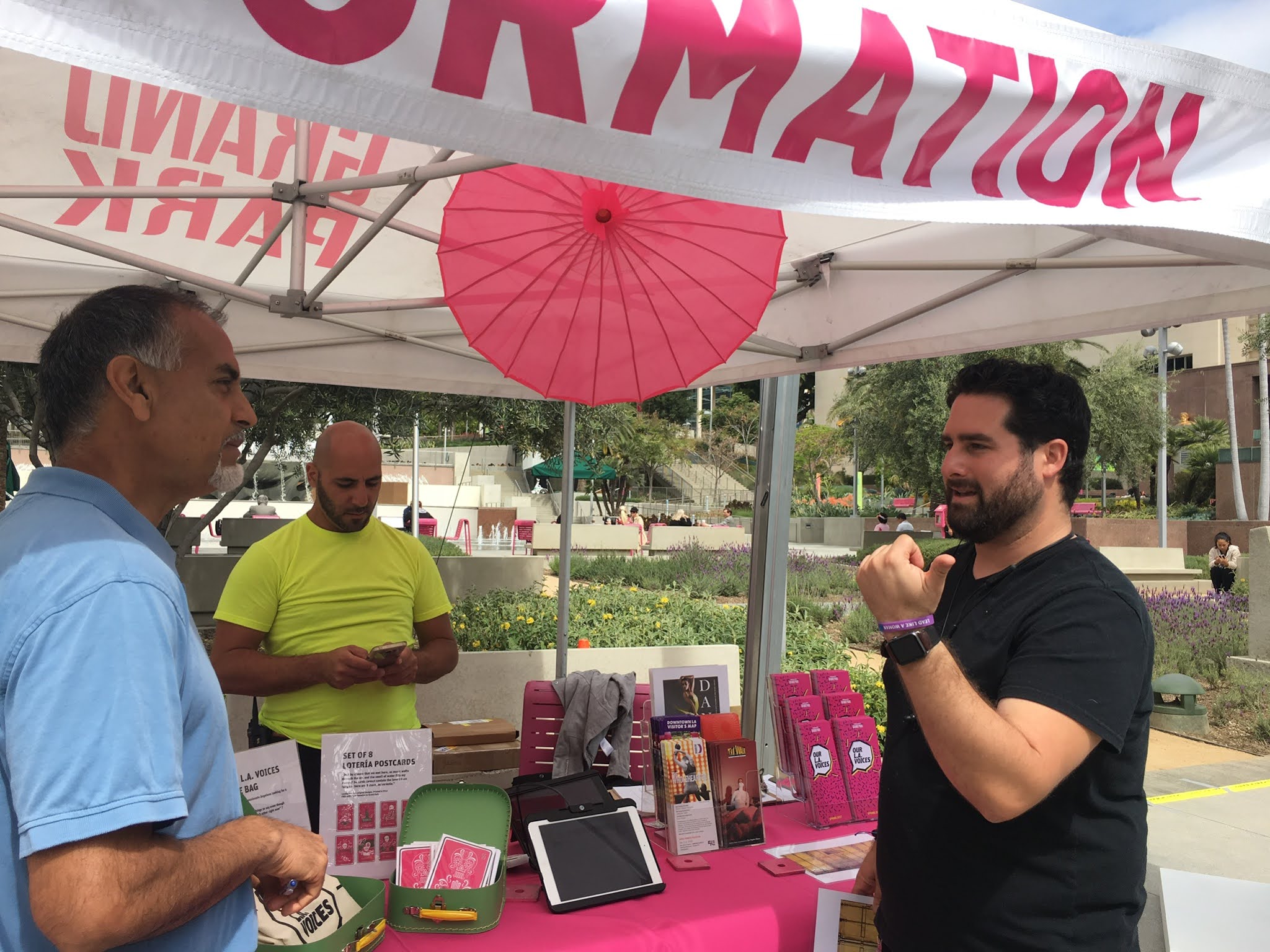
As news of the U.S. action filtered through, Fazeel Chauhan, 53, an analyst from Pomona, emerged from the darkness of the gold container into the mid-morning sun.
They had just been talking to three young men at the Harsham camp who were in a portal that had been converted from a disused pumping station. Some 1,500 Iraqi families who fled Mosul live at the camp.
Pakistani-born Chauhan gestured to two bulletin boards in the park where people had left post-it notes. One of them struck a chord. The writer noted that if people talked more often it could lead to world peace.

“I know with Trump it seems impossible because he just dropped the biggest bomb like it’s nothing,” Chauhan said. “If American people in general had more interactions with Muslim people or they knew about Islam, then they would not be easily manipulated by ideas like Muslims are trying to implement Sharia law or hate their women, or they’re violent, or they’re terrorists.”
At the ITA Luncheon
Fazeel Chauhan
At the ITA Luncheon
http://aliveemployeesclub.com/wp-content/uploads/ARCHIVE/2006/200603-Alive-airports-street-fair.pdf
Old Blogs of Fazeel Chauhan
Old Blogs of Fazeel Chauhan
1) Fazeel's writings
https://www.angelfire.com/poetry/sweets/
2) Fazeel's writings
https://www.angelfire.com/my/arms
3) Some links to Bulleh Shah, etc.
https://qawali.tripod.com/hybridaccents/id15.html
4) Men's groups and family of women:
https://www.angelfire.com/apes/sterling/
https://csulbsocialworkers.blogspot.com/
5) Wordpress site (under construction)
https://globalzebra.wordpress.com/tag/fazeel/
6) MySpace website, before there was Fakebook
https://myspace.com/qawali/photos
Reference to the 1996 articled: What Can I Do?
My article
"What Can I Do?"
Published in Pakistan Link. November 22. 1996. p. 5.
had this quote cited in the following research paper:
The trend toward medicine is so pronounced that an activist, who advises his fellow Muslims what they should do in America, tells them: "Teach the children to be leaders in government, media and community. Don't only become rich doctors."
refernce # 55
on page 13 of the following article:
Demographic Characteristics of the American Muslim Community
by Khalid Duran
https://archive.org/details/demographic-characteristics-of-the-american-muslim-community
Tuesday, March 9, 2021




Writer's Bio - 1999
(39) Writer's Bio
8-16-99
Fazeel Azeez Chauhan of
Los Angeles was born in Pakistan. He lived there off and on for ten years. As a
teenager, he lived for five years in Saudi Arabia. He's been living in the U.S.
since 1980
He attended California
State University and has a bachelor's degree in Computer Information Systems.
He also majored in Psychology in graduate school. At Los Angeles City College,
he completed a two year training program for Television Production. He also
studied Creative Writing. Since 1990, his articles on social issues are often
published in Pakistan-American weekly newspapers.
In 1991 he started
working for a large organization as a Computer Network Engineer. He continues
working in that profession full-time. His interests are hiking, traveling,
reading and writing poetry, music and community service
A collection of his poems will be published in the coming months.
Thank you joining me in reading.
Contact Information:
Art and Poetry page:
https://www.facebook.com/SubversiveVerse
Poetry and Essays:
https://globalzebra.blogspot.com/
Pakistani Railway Mafia
(33) Pakistani Railway Mafia
1998 by Fazeel Azeez Chauhan
In order to help
facilitate the looting of Indian treasures, the British decided to build decent
railways. Of course, it was the Indians who spilled their sweat and blood to do
the actual construction. Last month, during a visit to the Pak (sacred) land, I
experienced the unholiness of today's Pakistan Railways. My friend Shehky and I
had decided to take the round-trip from Lahore to Karachi by train.
We went to Lahore
Railway station, on the day of our trip. At the ticket counter, the clerk who
probably makes less than 2,000 Rupees ($40) a month, gave us a very bad
attitude. He was so rude that I couldn't even get a straight answer from him
about the train schedule. It was his negative way of exerting power to get a
sense of superiority over the customers. We finally discovered that there were
no tickets available. So Shehky took me to a restaurant across the street from
the station. There, in black market, we got two tickets for 1300 Rupees each.
Of course, the face value of each ticket was only 780 Rupees. Who made the 520
Rupees of profit on each ticket? The Railway Mafia.
This is nothing new,
everyone knows about the tickets being sold in black. Usually, a traveler only
has to ask a Kulee to purchase a ticket. It seems that railway workers on many
levels are part of this mafia ring. From the Kulees on up to the executive
management, everyone gets their share of the 520 Rupees profit from each
ticket. The biggest proof that they're all in it together, is that you will
never be able to buy a counterfeit ticket. That's because the Pakistan Railway
Mafia is so powerful, that they've destroyed the competition from any other
mafia. The tickets themselves are so simple that anyone could easily print fake
ones. But nobody has dared to do so to challenge the Pakistan Railway mafia.
At the Karachi station, the
Railway had displayed large banners announcing that they would not tolerate the
black marketing of tickets. "Violators will be jailed and fined" was
the main line of the drama. In Karachi, for the trip back to Lahore, the Kulees
were asking for 1500 Rupees per ticket. The Railway mafia falsely claimed that
it was now too risky to sell tickets in black. They used this trick to hike up
the prices even more. We got two tickets which ended up being in a women's
compartment. There are six bunk beds for the people in each compartment. The
other four people in our compartment happened to included two young women and
two young girls. The oldest was about 21 and did not like us being in her
vicinity, possibly because of my long hair and Shehky's earrings. Maybe we
don't look like two ideal "mama's boys". She contacted the Railway
authorities to have us moved, but they were of no help. Later she became a bit
friendly and gave a blanket and pillow to my friend who was feeling cold.
In the adjacent
compartment was a woman with her two daughters who were visiting from England.
Her sister was also there and she was obviously a sincere old timer from a
small town in Pakistan. She offered us a large plate of homemade Biryani. On
her genuine insistence we accepted and enjoyed the delicious meal. Their
younger daughter was about five years old and was playing house on the very top
bunk bed, which is about 5 feet above the ground. The poor girl rolled over and
had a terrible fall to the ground. But luckily, she was spinning during her
fall and thus miraculously didn't have any significant injuries. God does
protect his good people.
Guess what happened when
we arrived in Lahore from Karachi? My friend Shehky is an artist and has been
gradually moving his belongings to his new home in Lahore. He had a suitcase
full of metal tools and instruments for wood carving. As soon as we stepped off
the train, an officer of the mafia pulled us aside. He told us that each
passenger is allowed only 20 Kilograms of baggage. Anything heavier should have
been checked in and stored in the baggage compartment. This was a new rule,
which very few people knew about. In fact it's another trick for the mafia to
make money.
Here's how the Railway
mafia rips off people: The officer took us to a weighing machine. The machine
indicated that our suitcase weighed 65 Kg. At the top of the machine was a sign
that said "Warning - This machine can show inaccurate measurements at any
time". But nobody was paying any attention to this sign. We were asked to
pay 22 Rupees per Kg, totaling 1430 Rupees. We objected with agony. At that
time, a man wearing very nice white clothes appeared on the scene. At first he
seemed to be an employee of the railroad, but later turned out to be a taxi
driver, who was part of the Railway mafia. Bargaining, diplomacy and arguing
back and forth resulted in a bribe of 400 Rupees. This included the taxi fare
to our home. The kind gentlemen of the mafia assured us that we would get home
safe and sound.
When we arrived home, we
had to pay 400 Rupees to the taxi driver. He probably got 100 Rupees as his
cut. The other 300 Rupees went to his mafia friends at the Railway station.
Though the amount is only $8 for me, but for a person struggling in Pakistan,
400 Rupees is a lot of money. On a daily basis, the Railway mafia is thus
robbing hundreds of people. It's just another example of an elaborate
"number two" or fraud system created to make money for the
authorities. These people have the audacity to call themselves Pak- and
Muslims. It's estimated that 90% of Pakistanis don't even pay their electric bills
and pay bribes instead. Show a non-Muslim a few common things in Pakistan and
he will be convinced to never become a Muslim because we are such bad examples
of the faith. If "Cleanliness is Half the Faith" then Americans
practice half the teachings of Islam, but Pakistanis don't. Enough Pakistanis
are corrupt and not on the straight path of Islam. That's the cause of our
suffering and downfall
Subscribe to:
Posts (Atom)
As always, well written article about a very interesting being. Your article is thought provoking. It reminded me of poems by Allama Mohammed Iqbal, poet / philosopher from Pakistan / India. He is known as the reincarnation or continuation of Rumi. He frequently refers to “Shaheen” in his poetry. I believe it refers to Hawk, Eagle, Falcon, because to the layman like me, they seem to be all in the same family. Some of these are well known verses or couplets, some of which we were required to memorize, from our Urdu text books. I think he wrote more in Farsi than in Urdu. In Iran he is well known as Iqbal Lahori. As he resided in the historical city of Lahore, where is shrine is, right at the entrance of the Badshahi masjid.
Shaheen kabhi parwaz say thak kar naheen girta:
The eagle never falls down because of being tired.
Tu Shaheen hay, parwaz hay kaam tera:
You are a hawk, your work is to fly.
And this one, sung by Ustad Nusrat Fateh Ali Khan:
Naheen tera nashayman qasr-e-sultani kay gunbad par
Tu Shaheen hay basayra kar pahaRRon ki chatano’n par
You nest (home) is not on the domes of the palaces of kings
You are a falcon, hang out in the high cliffs of mountans
The first line also refers to the crowd, most people: pigeons hang out in warmth of the crowd, at domes where they are given food, where they don’t have to hunt, and can be in the comfort zone.
Whereas, an eagle is kind of solitary, flies much higher than a pigeon. Does it’s own hunting. Chooses the road less travelled.
Iqbal, as a philosopher repeats this idea, about the nature of human beings. That it’s our nature to choose that high road. The heat which will produce gold.
He was also using these ideas to inspire the Muslims of India, to kick the ass of the British, and to no longer live in slavery, which was called colonization.
Jhapat kar palatna, palat kar jhapatna:
Iqbal describes how an eagle hunts. It does not attack the prey from behind.
The eagle approaches the prey (bird) from the front, and at the first encounter, does a close call, a fly-by. A generous move, to allow the prey to get away, if it can.
Then the eagle turns, and returns to attack again.
Iqbal lived 500 years after Rumi, but often talked to him. Iqbal calls Rumi his spiritual master. In Rumi’s masnavi, there are many amazing stories, with multiple meanings. In his story about the Merchant and the Parrot. The parrot is in a cage. Some scholars see the metaphors as: The parrot is the ego. Or the human being locked in the cage of the body. The way to freedom, is to kill the ego. Like in Buddhism they say, ego is the I, me and mine, which desires so many things. In psychology and in common language, there are many definitions of ego. In sufism, they say annihilate the ego, to be on a spiritual path. Some teachers say the ego is necessary to survive in the world, as a tool. Though any tool can be used as a weapon. Ego defined in that way, is that thing which makes a man unique, it’s what pushes him to compete, to hunt, to win, it’s what drives him. But that ego needs to be reigned in. If a man does not control his ego, his ego will control him. And that ego kills relationship. Perhaps the ego is also what makes a person selfish, confined, limited, on the ground. While generosity makes a person fly like a hawk, like Shaheen